
Services
Warm, sealed, and properly ventilated.
Three things make an older house comfortable, and they are one job rather than three. The fourth goes on the roof. Each is set out below beside the work that proves it.
01
Internal wall insulation
Where a wall has no cavity to fill, the insulation goes on the inside — and the front of the house is left exactly as it was.
Wood fibre board fixed back to the masonry across every external wall, joints closed up, and the board carried right into the window reveals. A reveal left bare is a cold edge around every window, and it shows up as a dark line on the plaster long before anything else goes wrong.
Wood fibre rather than a foil-faced board, for two reasons. It is vapour-open, so the wall can still dry inwards instead of holding damp against the masonry. And it takes up moisture and gives it back again rather than letting it collect as water on a cold surface. The board is bedded tight to the wall for the same reason: air moving behind the insulation carries room moisture straight onto cold masonry, which is precisely where it turns back into water.
The same goes between floor and ceiling joists, and disused chimney breasts get dealt with at the same time. The honest trade-off is that the room loses an inch or two off each outside wall, and every reveal, socket and skirting has to be re-worked around the new thickness — that detailing is most of the labour, and it is what decides whether the job works.
02
Airtightness
Insulation only works if air is not moving through it. The airtight layer is what stops it, and it is won or lost at the junctions.
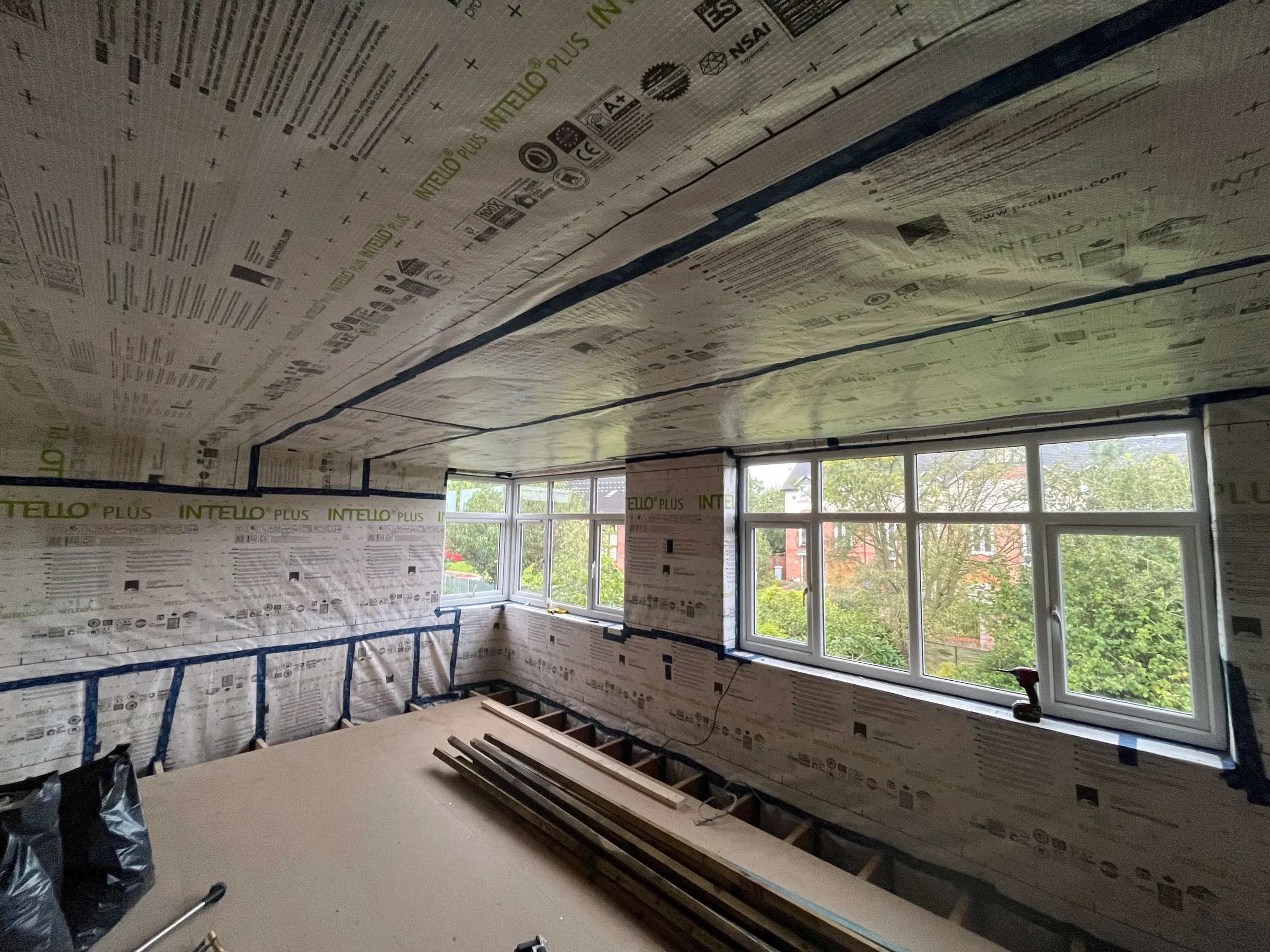
A membrane run across the inside face of the envelope — walls, ceilings, and the joint between them — taped continuously so there is no path for air to track behind the insulation. It is an intelligent membrane rather than a plain sheet of polythene: it tightens up in winter to keep moisture out of the build-up, and opens again in summer so anything that did get in can dry back into the room.
Rolling membrane across the flat of a wall is the easy half. The work is where the wall meets the floor, where a joist runs into the masonry, around every window reveal, and behind every socket and switch. That is where air actually moves, and it is what a blower door test finds.
Battens over the membrane leave a service void, so the sealed layer is not punctured every time a cable or a back box goes in. It is also the part that disappears — once the plasterboard is on nobody can inspect it, which is why every job on this site was photographed before it was closed up.
Internal wall insulationLarge room retrofitPorch airtightness
03
Ventilation and MVHR
A house that no longer leaks needs a deliberate way to change its air. Otherwise the moisture people make has nowhere to go.
MVHR stands for mechanical ventilation with heat recovery. It draws damp, stale air out of the kitchen and bathrooms, brings fresh air into the bedrooms and living rooms, and passes one stream across the other through a heat exchanger on the way — so most of the warmth stays in the house instead of going out through the wall with the old air.
It is not an extractor fan with ambitions. It runs continuously at a low rate, which is what actually holds humidity down; a fan that only runs when somebody remembers to switch it on is dealing with condensation after it has already formed on the window.
It belongs in the same job as the insulation and the airtightness. The ducts have to run somewhere, every one of them punctures the sealed layer, and each of those holes is easiest to seal properly as it is made. Fitting it afterwards means opening the work back up.
04
Solar panel systems
The part that sits on the roof: anchors set out and fixed to the rafters, rails levelled off them, panels landed and secured.
Roof anchors fixed through to the rafters rather than to the battens, with the tiles dressed back over them so the roof still sheds water the way it was built to. Rails set out true off the anchors, then the panels fixed down to the rails and squared up to the roof.
The electrical installation is not part of this. No inverter, no consumer unit, no connection to the house. That is a separate trade and a separate person. What is offered here is the mounted system on the roof itself.
It often lands on the same house as insulation work, for the obvious reason: there is limited sense in making electricity on the roof of a house that is throwing heat out through the walls.
Also taken on
The rest of what comes with opening a house up — and, often enough, the reason a house is opened up in the first place.
Renovation and kitchens
Strip-out and rebuild — studwork, ceilings, plasterboarding, electrics, joinery.
Lofts
Boarding, storage conversions, and hatches with proper ladder access.
Roofing and roofline
Roofing and chimney work, guttering, fascias and soffits.
Joinery
Gates, doors hung, flooring and general joinery.
Tell us what the house does that you don't like.
Cold rooms, draughts, condensation on the windows, a wall that never feels dry. Photographs help more than anything.